The Chair by the Window, and the Hour You Give It
Every house has one seat that nobody argues over. It sits near the glass, it is a little worn on one arm, and it faces slightly away from whatever screen is on in the room. This page is about claiming that seat for an hour a day and using the time to practise paying attention.
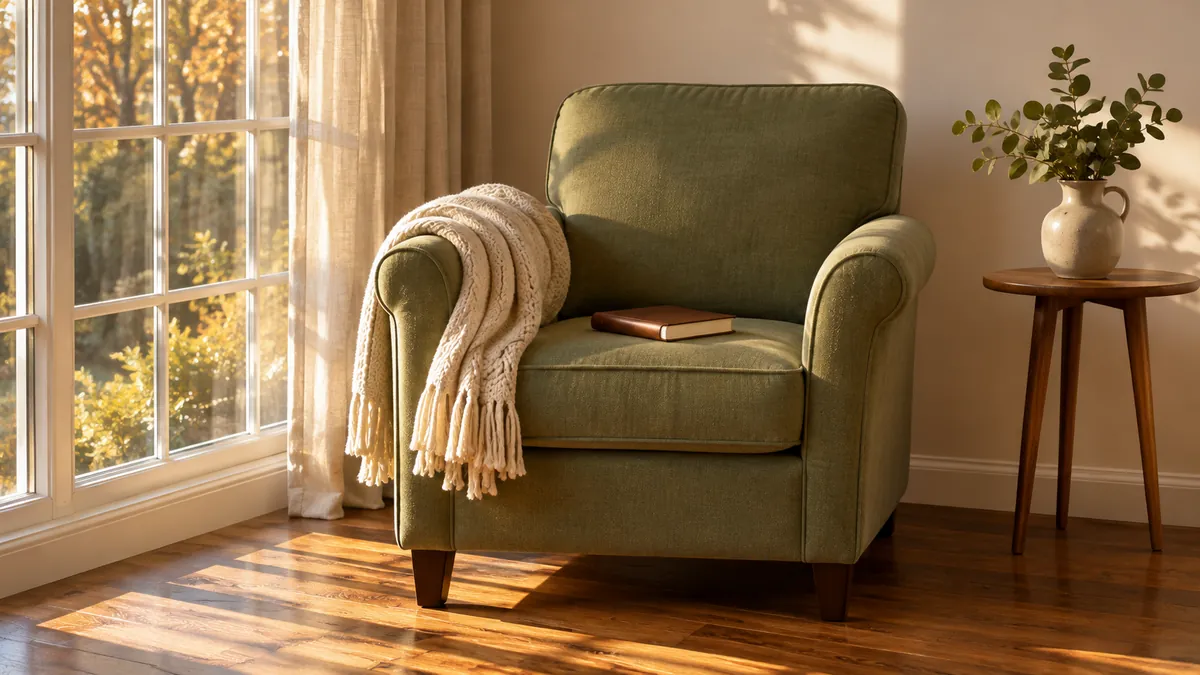
We build seats for a living, in a shed in northeast Brazil, and the question we hear most from people who buy one is not about foam density or fabric. It is some version of: where should it go? Our honest answer has become the subject of this section. Put it where the light comes in, and then give it a job.
The job is simple to describe and harder to keep. Once a day, for roughly sixty minutes, you sit in that one chair and do nothing that needs a screen. You are not resting in the sense of dozing, and you are not working in the sense of answering anything. You are keeping company with your own head. Plenty of people find that after fifty this is exactly the hour that has gone missing from the calendar, crowded out by notifications, errands and the radio of the day.
What follows is how we would set it up, broken into the same six stretches you will see marked down the side of the page.
Pick the seat before you pick the hour
Start with furniture, not with a schedule. A chair that already has a purpose (the one at the desk, the one at the dinner table) drags that purpose along with it. The seat you want is one that does very little else all day. If the house has none, move one. A single armchair angled toward a window, with a small surface within reach for a cup and a pen, is the whole kit.
Comfort matters, but so does a little firmness. A seat so deep that you sink to your shoulders tends to end in a nap, which is pleasant and is not the point. Feet flat, back supported, arms resting: the posture of someone who intends to stay awake and look around.
Choose an hour that already belongs to you
The easiest hour to protect is one nobody else wants. For some it is the stretch after breakfast, before the phone starts. For others it is the lull in mid afternoon when the house goes quiet, or the hour after supper when the dishes are done. Pick the slot that is least likely to be borrowed and attach the chair to it, the same way a dog learns that the leash on the hook means a walk.
Consistency does more work than length. Twenty minutes at the same time every day tends to stick better than an hour squeezed in whenever there happens to be space. The repetition is part of the exercise: a fixed appointment with yourself is one more thing the mind keeps track of without help.
Run the day backwards
Here is the first thing to do once you are seated. Close your eyes or fix them on something outside, and walk back through the day in reverse order. Where were you just before you sat down? Before that? What did you eat at noon, who spoke to you, what was the first thing you looked at after waking?
Going backwards is harder than going forwards, and that is why it is useful. The usual story of a day runs on rails; reversing it forces you to fetch each piece on purpose. You will notice gaps. Do not chase them hard. Simply note where the thread went thin and keep moving toward the morning. People who keep this up often say the gaps narrow over a few weeks, and that small details (a color, a remark, the weather at ten o'clock) start to come back more readily.
Three lines on paper
Next, open the notebook and write three lines. Not a diary entry, not a list of chores. Three plain sentences about something you noticed today that you would otherwise let slide: the name of the cashier, the song on the neighbor's porch, the price of tomatoes at the market stall.
Writing by hand slows the hand down to the speed of thought, and it leaves a record you can flip back through. Once a week, read the last seven days of lines before you write today's. You may be surprised by how much those small entries pull back with them. If three lines feels like too little, keep it at three anyway. The limit is what makes it easy to do every single day.
The window, with no screen in between
Now put the pen down and simply look out. Pick one thing in the view (a tree, a parked truck, a rooftop) and study it the way you would study a painting you had paid to see. What has changed since yesterday? Which way is the wind moving the leaves? How many windows across the street are lit?
This is where the hour earns its name. For most of the day our attention is pulled in short bursts from one bright rectangle to the next. Ten minutes of steady looking at something that is not trying to hold you is a different kind of exercise, closer to tuning an instrument than to playing it. Some readers like to finish this stretch by describing the view out loud, quietly, in a single sentence. It sounds odd and it works well as a way to close the hour on a clear note.
Start with ten minutes, not sixty
An hour is the goal, not the first step. In the opening week, sit for ten minutes and do only one of the three things: run the day backwards on Monday, write the three lines on Tuesday, watch the window on Wednesday. In the second week, go to twenty minutes and do two of them. By the fourth week most people can manage the full sequence without checking the clock.
If a day is missed, do not make it up with a double session. Just sit down at the usual time the next day. The chair will still be by the window. That is the quiet advantage of building a habit around a piece of furniture: it waits for you without complaint, in the same spot, every afternoon.
And if you live with someone, tell them what the hour is for. A partner who knows that the chair by the window means "back in sixty minutes" is the best protection the habit will ever have.